
Mummy berry is a fungal disease of major importance, it causes considerable damage to blueberries. Severe blighting of the leaves, shoots, and flower buds some cultivars are more susceptible than others.
A single apothecia cup or mummy berry mushroom – can release in excess of a million spores in under a week. If you plan to apply a fungicide Knowing when the spores are being released is vital.
Fungicide applications should begin in early spring, as the green buds emerge. New growth remains susceptible to Mummy Berry until shoots are about 2 inches in length, so fungicides should be re-applied at recommended intervals {as per label instructions}, usually weekly.
Fungicides effective for treatment of Mummy Berry are propiconazole and Indar which are both in the same class of chemicals.
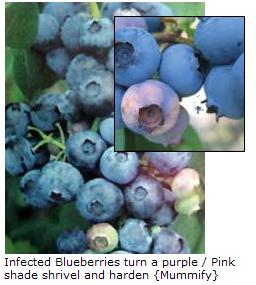
There are many other fungicides labeled as effective for treatment of Mummy Berry, not all are available to home gardeners. Some general purpose fungicides are effective also. Check labels carefully before purchasing or using.
Anthracnose
The anthracnose fungus causes dark brown, oval sunken areas or spots on stems. It also causes the crown to rot, which causes young leaves to wilt. The fungus can be carried on apparently healthy plants. Therefore, be sure to use healthy certified plants for transplanting.
Avoiding excess moisture during the summer will help decrease the severity of this disease. In the spring, look for orange spore masses on last year’s fruiting stems. Look for blighted shoot tips and flowers turning black or brown. When fruit are beginning to ripen, look for sunken, shriveled berries. Riper fruit may show the orange spores. Anthracnose cannot be controlled adequately by fungicides.

Bluecrop, Berkeley, Coville, Earliblue, Herbert, Jersey and Spartan are some varieties prone to anthracnose.
Collins, Elliot, and Weymouth are considered resistant to Anthracnose. There are no completely 100% resistant varieties when the weather is favorable for disease development. Once anthracnose is detected all affected plants should be removed and destroyed, residue burnt or properly disposed of – tools thoroughly cleaned to prevent the spread of the disease.
Botrytis Blight
A fungal disease, a/k/a gray mold, infects leaves, stems, flowers, and bulbs of many plants, in addition to blueberry it also attacks strawberry, grape, raspberry, blackberry, artichoke, asparagus, cucumbers, onions etcetra.
Gray mold infects dead or dying tissues first, and then spreads to living tissues. Lesions are brown to gray circular spots that later become fuzzy, producing gray masses of fungal spores. Cool, damp weather favors the development and spread of this disease.
Avoid crowding plants and overhead watering ,drip systems are preferable.
Prune away and discard diseased tissue. Maintain healthy plants by locating them properly, fertilize at the right time of year with the proper nutrients, and keep a 2-3-inch layer of mulch around the base of the plants.
Fungicides are available, Bonide Remedy Fungicide has proven effective against Botrytis Fruit rot.
Any fungicides registered for grey mold control must be applied before infection takes place, they won’t cure an existing infestation. If you’ve had problems with gray mold in the past apply fungicide before the infestation gets to the plant.
Stem Blight
A Fungus which causes rapid wilt with browning or reddening of leaves on individual branches, frequently followed by plant death as the fungus spreads. Most infections can be traced to a wound as the initial point of infection.
Cold injury has also been observed to cause cracking in the forks of blueberry stems, leaving plants susceptible to early Spring infestations.
Control of stem blight can be managed through proper cultural methods such as site selection, the use of resistant cultivars, clean planting stock, nutrient management to avoid over-fertilizing and subsequent winter injury, and selective pruning to remove infected canes.
Fungicides do not work well on stem blight, but are helpful if applied immediately after pruning or other events that may damage the plant.
Twig Blight is a similar disease of blueberry plants, it causes a dieback of fruit-bearing twigs on rabbiteye and highbush blueberry.
Downy Mildew
Is similar in appearance and often confused with powdery mildew. It is a frequent problem for vine type small fruits such as grapes, and some vegetables such as cucumbers and onions. It is not a common problem with most blueberry cultivars. Mancozeb or Dithane are both effective against Downy Mildew.
Blueberry shoestring Virus
A serious problem for commercial planters and home growers. Remove any plants exhibiting bright red streaks or strap-like leaves. If blueberry shoestring virus is observed in a planting, aphid~ insect control with malathion or Sevin is warranted and should be carried out ASAP.
The Blueberry shoe-string virus is largely transmitted by aphids. Transmission begins when aphids emerge in the spring and end just before Autumn leaf drop.
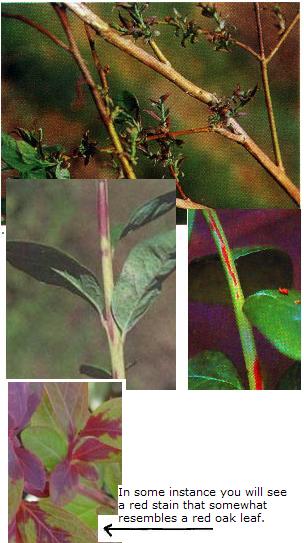
Aphids move from bush to bush as they feed. carrying the disease with them. Leaves infected with Blueberry shoe-string virus are reddened and strap like, or crescent-shaped. Red patterns may also emerge on foliage. Flowers may have a light red or pink tinge or purple to deep red streaks. Berries remains reddish and don’t turn blue.
There is no reliable chemical control for this disease, proper control of insects is the best prevention. BSSV generally does not destroy the plant , but greatly reduces the yield as well as the desirability of the berries.
Bluecrop, Bluejay, Darrow, and Northland are resistant to Blueberry shoestring Virus.
Powdery Mildew
During mid-summer foliage is covered by a web-like fungus growth called mycelium. As a result, leaves become puckered . In late summer, circular reddish-brown spots 1/8 to 1/4 inch in diameter appear on the top and underside of the leaves. Conidiophores grow from the mycelium and spread the disease throughout the field. During the late summer and autumn, small round black fruiting bodies [cleistothecia] 1/32 to1/16 inch in diameter develop on the surface of the fungal growth on the leaves. The cleistothecia are a means of over wintering by the fungus. All cultivars are susceptible to powdery mildew. Jersey cultivar is the most susceptible.
Sulfur based fungicides are best used against powdery mildew. They are less damaging to fruit and foliage than other fungicides, although their use in very hot weather may still result in some leaf burn. Sulfur fungicides are highly effective for the control of powdery mildew but are not good for most other fruit crop diseases. Sulfur is lethal to some beneficial insects.